XCC
A Universal Communication Interface Composer for Heterogeneous Systems
Nikola Stojkov and Igor Dejanović
University of Novi Sad, Serbia
The Integration Challenge
Heterogeneous Systems with multiple CPU cores, accelerators, FPGA, and specialized processors
Fragmented Communication Design scattered across code, config files, and architectural diagrams
Multiple Teams & Platforms (Linux, RTOS, bare-metal) → inconsistent communication interfaces
Communication is critical but difficult to design systematically
Static vs. Dynamic Trade-off
Dynamic
- Flexible for changes
- Runtime overhead
- Higher latency
- Unpredictable
Static (Compile-time)
- Optimizable
- Low overhead
- Predictable latency
- Analyzable
✓ Desired: Static design with architectural flexibility
XCC: The Solution
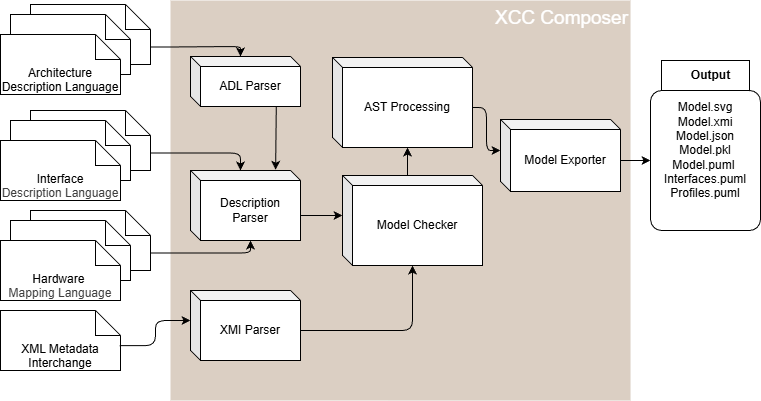
Domain-Specific Language (DSL) for systematic communication composition
OR UML Models via XMI import
Captures: Connectivity + Contracts + Profiles
XCC: DSL Core Aspects
① Architecture Description (ADL)
Define system topology and component connectivity
② Interface Description (IDL)
Specify message formats, access control, and integrity
③ Hardware Mapping (HML)
Capture communication profiles and performance constraints
Architecture Description (ADL)
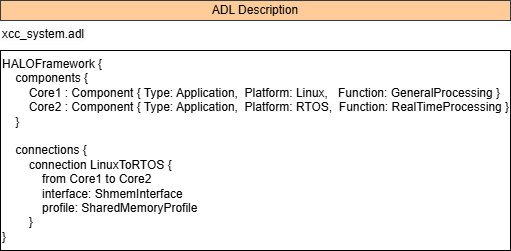
Define system components and their communication topology
Interface Definition (IDL)
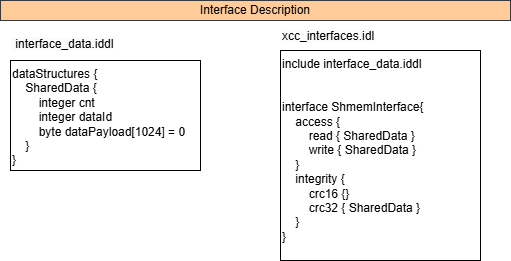
Specify communication contracts and message structures
Hardware Modeling (HML)
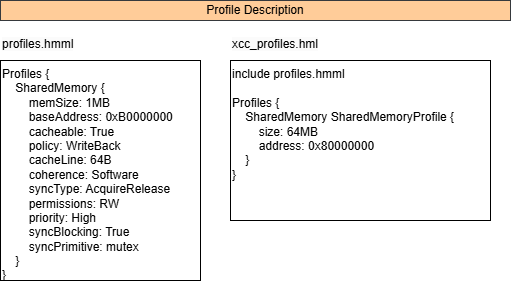
Capture communication profiles and platform-specific performance constraints
From Specification to XCC-AST
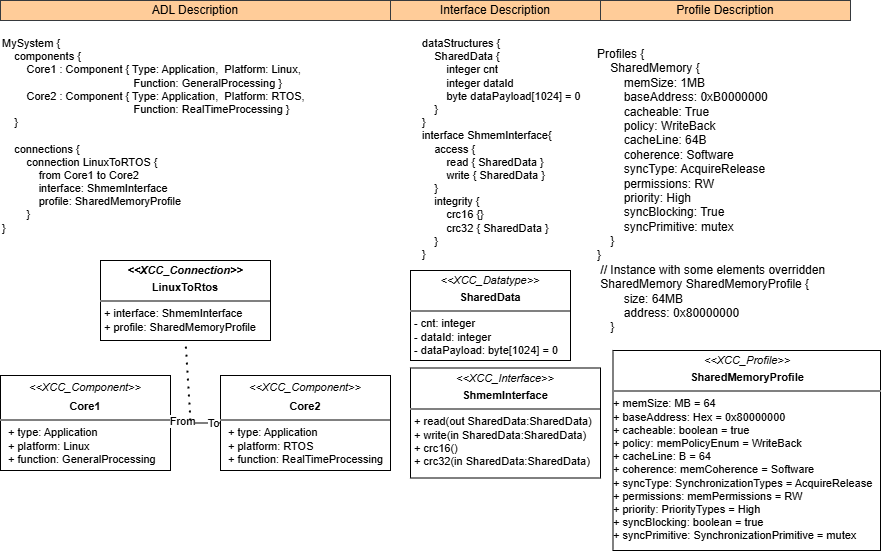
TextX syntax for DSL grammar • UML Tags mark XCC components
DSL Grammar Examples
ADL Grammar
							ComponentDef:
								name=ID ':' 'Component' '{'
									'Type' ':' type=ID ','
									'Platform' ':' platform=ID ','
									'Function' ':' function=ID
								'}'
							ConnectionDef:
								'connection' name=ID '{'
									'from' src=[ComponentDef]
									'to' dst=[ComponentDef]
									'interface' ':' interface=ID
									'profile' ':' profile=ID '}'
IDL Grammar
							Interface: 'interface' name=ID '{'
								data=DataStructures?
								access=Access
								integrity=Integrity? '}'
							StructDef:
								name=ID '{' fields+=Field* '}'
							Field:
								type=Type name=ID array=ArraySpec?
							Access: 'access' '{'
								(readLines+=ReadAccess |
								writeLines+=WriteAccess)+ '}'
HML Grammar
								SharedMemory:
									'SharedMemory' name=ID? '{'
										items+=Attribute* '}'
								Attribute:
									key=ID ':' val=Value
								Value:
									Size | Hex | STRING |
									Boolean | INT | ID
								Size: value=INT unit=Unit
								Unit: 'B'|'kB'|'MB'|'GB'
From XCC-AST to Code Generation
XCC-AST: Abstract syntax tree with communication semantics in PKL and JSON formats for downstream code generation.
✓ Traceability from spec to generated code
✓ Optimized code: Static resource allocation, predictable patterns, platform-specific
Key Benefits
✓ Traceability: Full mapping from spec to generated code
✓ Minimizing integration overhead: No manual code changes for communication in heterogeneous systems
✓ Systematic Design: Single source of truth for communication
✓ Late Changes Safe: Architectural evolution without breaking system
XCC: Making it Practical
XCC bridges the gap between architectural specification and implementation reality trough code generation
Result: Teams can design communication interfaces systematically, validate them early, and evolve them safely
Questions?
nikola.stojkov@outlook.com